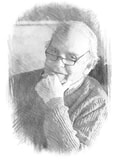
Frederick Buechner (pronounced BEEK-ner) is an American writer and theologian. He is the author of thirty-nine published books and has been an important source of inspiration and learning for many readers. His work encompasses many genres, including fiction, autobiography, essays, sermons, and other nonfiction. Buechner’s books have been translated into twenty-seven languages for publication around the world. Buechner’s writing has often been praised for its ability to inspire readers to see the grace in their daily lives. Buechner has been called a "major talent" by the New York Times, and "one of our most original storytellers" by USA Today. Annie Dillard (Pulitzer Prize-winning author of Pilgrim at Tinker Creek) says: "Frederick Buechner is one of our finest writers." As stated in the London Free Press, "He is one of our great novelists because he is one of our finest religious writers." He has been a finalist for the Pulitzer Prize and the National Book Award, and has been awarded eight honorary degrees from such institutions as Yale University and the Virginia Theological Seminary. In addition, Buechner has been the recipient of the O. Henry Award, the Rosenthal Award, the Christianity and Literature Belles Lettres Prize, and has been recognized by the American Academy and Institute of Arts and Letters.
|
Frederick Buechner’s many benedictions Frederick Buechner was arguably the foremost spiritual writer of his generation. His writing career spanned six decades, during which he wrote more than 30 books. His work has been translated into 27 languages. One of his books (Lion Country) was nominated for the National Book Award and another (Godric) was nominated for the Pulitzer Prize. During the 1980s and 1990s, he was quoted from American pulpits more often than anyone alive at the time. He was the rare author who appealed to both mainline Protestants and evangelicals. What is even more remarkable is that he was a master of four distinct genres: novel, sermon, popular theology, and memoir. He might have won the literary equivalent of a pentathlon if he had pursued a fifth genre—short stories. The only one he ever published, early in his career, won the O. Henry Award. (Christian century October 2022) READMORE>>>>> Why You Should Read Frederick Buechner Becoming a Christian is, generally speaking, bad for a novelist’s career. With some exceptions to this this rule (Marilynne Robinson, for one), a committed Christian in the world of letters faces bewildered misunderstanding from the literary community and, often, a Christian community expecting every story to follow the plotline of “Amazing Grace.” Someone compelled by both a gospel faith and a literary vision will sometimes end up forgotten by both communities. That is, I suppose, how Frederick Buechner ended up in exile here among the born again. Despite the fact that Buechner was a groundbreaking and award-winning novelist even in his early 20s, he’s not remembered in the world of The New York Review of Books alongside, say, a John Updike or a John Cheever. And despite being drawn back to the church and ordained to ministry after listening to a George Buttrick sermon, Buechner is hardly as celebrated as one would expect among his Union Seminary mainline Protestant ecosystem. Much of that sector of American religion has moved on to forms of theology that would see Buechner as hopelessly retrograde compared to various liberation theologies and deconstruction philosophies now in fashion. Instead, when one finds a person whose life is changed and shaped by reading Frederick Buechner, more often than not, that person is an evangelical like you and me. (Russell Moore; The Gospel Coalition; 11/13/19) READMORE>>>>> “Go where your best prayers take you.” ― Frederick Buechner
Frederick Buechner
Some think of a Christian as one who necessarily believes certain things. That Jesus was the son of God, say. Or that Mary was a virgin. Or that the Pope is infallible. Or that all other religions are all wrong. Some think of a Christian as one who necessarily does certain things. Such as going to church. Getting baptized. Giving up liquor and tobacco. Reading the Bible. Doing a good deed a day. Some think of a Christian as just a Nice Guy. Jesus said, "I am the way, and the truth, and the life; no one comes to the Father, but by me." (John 14:6) He didn't say that any particular ethic, doctrine, or religion was the way, the truth, and the life. He said that he was. He didn't say that it was by believing or doing anything in particular that you could "come to the Father." He said that it was only by him—by living, participating in, being caught up by, the way of life that he embodied, that was his way. Thus it is possible to be on Christ's way and with his mark upon you without ever having heard of Christ, and for that reason to be on your way to God though maybe you don't even believe in God. A Christian is one who is on the way, though not necessarily very far along it, and who has at least some dim and half-baked idea of whom to thank. A Christian isn't necessarily any nicer than anybody else. Just better informed.....A Christian is one who points at Christ and says, "I can't prove a thing, but there's something about his eyes and his voice. There's something about the way he carries his head, his hands, the way he carries his cross—the way he carries me.” -Frederick Buechner; Peculiar Treasures
Frederick Buechner
“Stop trying to protect, to rescue, to judge, to manage the lives around you . . . remember that the lives of others are not your business. They are their business. They are God’s business . . . even your own life is not your business. It also is God’s business. Leave it to God. It is an astonishing thought. It can become a life-transforming thought . . . unclench the fists of your spirit and take it easy . . . What deadens us most to God’s presence within us, I think, is the inner dialogue that we are continuously engaged in with ourselves, the endless chatter of human thought. I suspect that there is nothing more crucial to true spiritual comfort . . . than being able from time to time to stop that chatter . . . ”
― Frederick Buechner, Telling Secrets “Life is grace. Sleep is forgiveness. The night absolves. Darkness wipes the slate clean, not spotless to be sure, but clean enough for another day's chalking.” ― Frederick Buechner, The Alphabet of Grace
Frederick Buechner
“Of the Seven Deadly Sins, anger is possibly the most fun. To lick your wounds, to smack your lips over grievances long past, to roll over your tongue the prospect of bitter confrontations still to come, to savor to the last toothsome morsel both the pain you are given and the pain you are giving back--in many ways it is a feast fit for a king. The chief drawback is that what you are wolfing down is yourself. The skeleton at the feast is you.”
― Frederick Buechner “The grace of God means something like: Here is your life. You might never have been, but you are because the party wouldn't have been complete without you.” ― Frederick Buechner
“It is as impossible for man to demonstrate the existence of God as it would be for even Sherlock Holmes to demonstrate the existence of Arthur Conan Doyle.” ― Frederick Buechner, Wishful Thinking: A Seeker's ABC
Frederick Buechner
“Stop trying to protect, to rescue, to judge, to manage the lives around you . . . remember that the lives of others are not your business. They are their business. They are God’s business . . . even your own life is not your business. It also is God’s business. Leave it to God. It is an astonishing thought. It can become a life-transforming thought . . . unclench the fists of your spirit and take it easy . . . What deadens us most to God’s presence within us, I think, is the inner dialogue that we are continuously engaged in with ourselves, the endless chatter of human thought. I suspect that there is nothing more crucial to true spiritual comfort . . . than being able from time to time to stop that chatter . . . ” ― Frederick Buechner, Telling Secrets
|
August 15, 2022: Netvue posted: Many readers will immediately associate the name Frederick Buechner with a passage from Wishful Thinking that they know by heart: “The place God calls you to is the place where your deep gladness and the world’s deep hunger meet.” It’s a rich sentence, full of possibility, and has been foundational for many of us in helping students through vocational discernment. But Buechner said a great deal more about vocation, whether in essays or fiction or memoir, and I’d like to explore his wider vision briefly as we mourn his death at the age of 96. Christianity Today posted: Buechner died peacefully in his sleep on Monday (Aug. 15) at age 96, according to his family. Born Carl Frederick Buechner on July 11, 1926, in New York City, he moved frequently with his family in his early childhood as his father searched for work, settling in Bermuda after his father’s death by suicide when he was 10. His studies at Princeton University were interrupted by World War II, but he completed his bachelor’s degree in English in 1948. He quickly achieved fame with the 1950 publication of his first novel, “A Long Day’s Dying.” When his second novel, in his own words, “fared as badly as the first one had fared well,” he moved to New York City to lecture at New York University and focus on his writing. August 17, 2022: Broad Street Presbyterian Church wrote: Author and theologian Frederick Buechner died on August 15, 2022, at age 96. His books have been beloved companions, for me as well as for so many colleagues in ministry. Buechner’s ability to see life, all of life, through the lens of faith lifted our spirits and strengthened – even saved – many a sermon! His way with words…it was both gift and craft. In gratitude for Buechner’s voice and memory, I share his reflection on Life from Wishful Thinking: The temptation is always to reduce it to size. A bowl of cherries. A rat race. Amino acids. Even to call it a mystery smacks of reductionism. It is the mystery. As far as anybody seems to know, the vast majority of things in the universe do not have whatever life is. Sticks, stones, stars, space – they simply are. A few things are and are somehow aware of it. They have broken through into Something, or Something has broken through into them. Even a jellyfish, a butternut squash. They’re in it with us. We’re all in it together, or it in us. Life is it. Life is with. After lecturing learnedly on miracles, a great theologian was asked to give a specific example of one. “There is only one miracle,” he answered. “It is life.” Have you wept at anything during the past year? Has your heart beat faster at the sight of young beauty? Have you thought seriously about the fact that someday you are going to die? More often than not do you really listen when people are speaking to you instead of just waiting for your turn to speak? Is there anybody you know in whose place, if one of you had to suffer great pain, you would volunteer yourself? If your answer to all or most of these questions is No, the chances are that you’re dead. Life with Frederick Buechner was deep and abundant. His imagination and insight and his humor enriched our study of the Bible’s people – who are in reality ourselves – their God, and our knowledge of one another. Today we give thanks to God for the life of Frederick Buechner. August 17, 2022: Christianity.com posted: By the time Buechner passed away at 96 years old on August 15, 2022, the New York Times reported that he'd published 39 books translated into 27 languages, with critics comparing him to Mark Twain, Henry James, and Truman Capote. Christianity Today published a memoriam article by Russell Moore and republished a 1997 profile by Philip Yancey. Yancey described meeting Buechner in 1979 and observed, “I have a hunch, in fact, that Buechner has become the most quoted living writer among Christians of influence.” August 17, 2022: Brent Dickieson posted: Like many, I was saddened to hear of the passing of Frederick Buechner on Monday 15 August. He was 96 and is survived by his wife Judith who he married in 1956. I always think of Buechner as a theologian and preacher, though most remember him as a novelist, justifying their choice by pointing to his 39 books, one of which (Godric) was a finalist for the 1981 Pulitzer Prize – so this is no light weight we are talking about. Ordained as a Presbyterian minister, he never pastored a church, but through the honesty and the depth of insight in his writing he was, in many ways, a pastor to hundreds of thousands. August 21, 2022: Brian Harris posted: Like many, I was saddened to hear of the passing of Frederick Buechner on Monday 15 August. He was 96 and is survived by his wife Judith who he married in 1956. I always think of Buechner as a theologian and preacher, though most remember him as a novelist, justifying their choice by pointing to his 39 books, one of which (Godric) was a finalist for the 1981 Pulitzer Prize – so this is no light weight we are talking about. Ordained as a Presbyterian minister, he never pastored a church, but through the honesty and the depth of insight in his writing he was, in many ways, a pastor to hundreds of thousands. September 18, 2022: Scott Pearson wrote: Some Wheaton students said that his writings contained a great deal of meaning to them, a sentiment I would share and Buechner appreciated. They said that his writings spoke of a faith that they longed for, perhaps better even than the Bible. Buechner is not a huge Bible guy. As a minister, he read it, but not every day. He found value in other literature, too. But he thought that the Bible’s classic and timeless nature was something that should be appreciated when looking at the faith. Perhaps this speaks more towards the inwardness of the evangelical world more than the quality of Buechner’s pen. Buechner’s memoirs also spoke of the loneliness and pain of losing a father so young. His family didn’t talk about it much, if at all. For better or for worse, they let life be their therapy. It seemed that writing these memoirs also became Buechner’s therapy as well. Writers often have painful events in their past that provide them with a unique perspective on human nature. Certainly, Buechner had just that. I appreciated his introspection and willingness to comment on the inner life of an intellectual. So much of the religious world around me was focused on taking over the world for Christ; I had enough trouble taking over just me for Christ, and Buechner helped me in that process. Frederick Buechner died peaceably at his home in Vermont on August 15, 2022, at the age of 96. He was remembered in numerous publications, ranging from the Princeton Alumni Magazine and Christianity Today magazine for evangelicals to the Washington Post and the New York Times. May 2, 2000: Frederick Buechner gives a sermon at St. Paul's Episcopal Church in Chattanooga, TN.
|


